projects
mental health narratives
2026 - present
In partnership with the Division of Student Affairs and Jen Wegmann (Binghamton University), my FRI students and I are leading research to uncover students’ beliefs about mental health and to design mental health workshops. Our workshops, designed by students and for students, aim to help participants take a step toward mental health promotion/prevention, support their friends’ mental health, and improve a group’s mental health (in a club or residence hall).
zero-sum beliefs & health care
2025 - present
With FRI students, we pilot tested an expanded zero-sum beliefs scale that extends a single gender item into a broader social identity scale, including items on health care access for undocumented immigrants, people with disabilities, and universal coverage, with a quota sample of 125 U.S. adults balanced across party affiliation (Khan, Hei, John & McCarty, in prep). Republican affiliation and higher subjective social status predicted stronger zero-sum social identity beliefs. Now we are examining the relationship between zero-sum beliefs and lack of support for universal health coverage.
commercial determinants of mental health
2022 - present
Lisa Cosgrove, Cole Cooper, Connor Sayle, and I are applying the commercial determinants of health (CDoH) framework to population mental health. We aim to explore how commercial influences shape the incidence of mental distress, the diagnosis of mental disorders, and the interventions that get funded and studied. In a commentary in Community Mental Health Journal, we use the CDoH framework to analyze the dominant mental health narratives that frame the mental health crisis as an individual problem, encourage mental health screening, and support the commercialization of mental health, and we offer narratives robust enough to support care across the whole continuum: mental health promotion and prevention, treatment, and recovery-oriented solutions (Cosgrove et al., 2026).
At SCRA 2025, we presented a poster re-analyzing 100 interventions targeting the social determinants of mental health drawn from a decade of systematic reviews. Ninety-four targeted individuals (i-frame) and 87 pursued first-order change, while only three were systems-level (s-frame) and none aimed to build an alternative to the biomedical paradigm. Ameliorative, individual-level interventions dominate the field, and we suspect that pattern reflects commercial influence on research priorities, including a growing for-profit social determinants of health industry.
moral reckoning on structural racism and structural thinking
2021 - present
Megan Liskey, Deepu George (University of Texas Rio Grande Valley), and I describe a pathway toward a moral reckoning on structural racism (McCarty et al., 2023). We call on community psychologists to examine structural factors, encourage structural thinking, and support structural intervention. Political and commercial determinants hold structural racism in place; structural thinking is the antidote.
With FRI students, we built structural thinking into the three-semester public health research experience, whose students are predominantly pre-health, and we are evaluating changes in their attributional thinking (Burton et al., 2026).
COVID-19 safety corps
2020
To engage youth as leaders during the pandemic, Natalie Cook (Virginia Tech) and I involved students in the design of new virtual curriculum: the COVID-19 Safety Corps (inspired by Michigan’s Urban Safety Corps). With Virginia Tech PRISM, we taught two cohorts of high school and college students the basics of promotion-prevention science and social media campaign development. Students from South Texas, Central Ohio, and Northern Virginia developed social media campaigns on mental health.
contain the contagion to prevent COVID-19
2020
With community activists, our team launched the Contagion the Contagion campaign to spread public health information to community members in the Rio Grande Valley (RGV) through an op-ed in March 2020 (Gonzalez, McCarty, Diaz, Garcia, Palacios, Martinez, Fuentes, Salas, Altamirano, Díaz-Santana & Prado, 2020). From March to June 2020, we reached 28,000+ South Texans through volunteer-led efforts to phone and text bank.
team-based medicine
2018 - 2020
To support integrated behavioral health (IBH) within UTRGV-affiliated primary care clinics on the US-MX border, I developed and implemented a team-based curriculum on mindsets for medical residents and mental health providers to work more collaboratively and share power. As part of a HRSA (HHS) grant, I co-led focus groups on wellness and resilience with medical learners during the pandemic with the goal of improving programs through (top-down) policy change and (bottom-up) student-led well-being committees (McCarty, Arellano, Garcia, Hernandez, & George, 2020).
youth participatory action research
2018
With funding from the Berkeley Initiative for Transparency in the Social Sciences (BITSS), Nikki Turgeon-Williams and I co-created a 4-week youth-led analytics course for AP Psychology students using a participatory action research approach, open and transparent research guidelines, and relevant models to guide their research studies (on social media, technology, character, mental health, and school climate) after they took their AP exam (see course materials: McCarty, Turgeon-Williams & Pacqué, 2018).
mental health clubs in high schools
2017 - 2022
Our nonprofit team consulted with Our Minds Matter (OMM) to redesign their mental health curriculum and improve their youth-led club model (to more effectively promote mental wellness) in Fairfax County Public Schools (VA). With colleagues, I conducted research on OMM leaders’ prosocial behavior and conducted a simple program evaluation using transparent methods in RMarkdown (see McCarty & Burns, 2020; McCarty & Gatto, 2020). Now, we are currently exploring individual health behavior change strategies (e.g., sleep hygiene practices as a depression prevention strategy), the influence of political ideology and mental health conceptions (e.g., as wellness or psychopathology), and how to build effective school-wide mental health campaigns.
upstanding for promotion-prevention
2017 - present
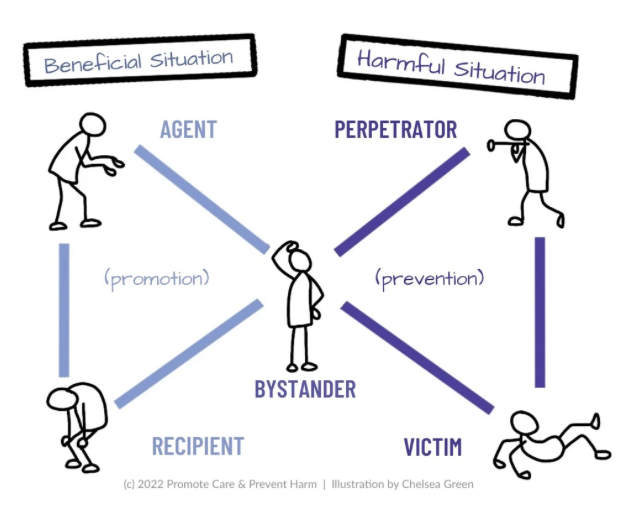
In collaboration with Sandy Hook Promise, our nonprofit team implemented the Say Something program and our UPP program to promote peace and prevent bullying in an Ohio high school. Jordan Booker (University of Missouri), Amanda Nickerson (University at Buffalo), Promote Care & Prevent Harm advisors, and I are preparing manuscripts on the UPP model (McCarty et al., 2022), UPP program (McCarty et al., 2021), an evaluation of an integrated promotion and prevention bystander approach (Booker et al., 2024), and an empirical test of the UPP model (Booker et al., in prep).
youth-led promotion & prevention
2016 - 2019
In 2016, we launched the Cor Foundation (later renamed Promote Care & Prevent Harm). With support from community-based partners, our nonprofit team developed and delivered elements of the youth-led promotion and prevention (YL2P) program in 11 high schools across Ohio to address the protective and risk factors associated with mental health, substance use, bullying, and related social problems. The interactive workshop engages teams of students to address the promoting pathway or protecting pathway (Kia-Keating et al., 2011). In a Virginia high school, we piloted the program in an elective leadership course with students in the student government.
school-based policing
2015 - 2018
With funding from the COPS Office, sociologist and curriculum development expert Jennifer Panagopoulos and I co-developed an in-person and e-learning course on school climate for school-based law enforcement (SROs and SSOs) and educators. The goal was to change the way school-based law enforcement and school administrators think about and address school climate and discipline practices, in order to end the school-to-prison pipeline. We co-facilitated a curriculum review with the leadership of the National Association of School Resource Officers (NASRO), and with two NASRO trainers I co-trained SROs, SSOs, and educators in three Maryland school districts, including Baltimore City Public Schools. Preventing Problems by Promoting Positive Practices included several modules on school climate and discipline, and the curriculum was incorporated into the 40-hour, state-mandated SRO program by the Maryland Center for School Safety. A second COPS grant funded an e-learning course on the COPS training portal (Panagopoulos & McCarty, 2020).
youth-led resilience promotion
2012 - 2021
To increase resilience during COVID-19 recovery, we wrote about how youth leaders in high school can promote resilience with Alyssa Gatto (Virginia Tech) and Ruby Charak (University of Texas Rio Grande Valley) (McCarty, Pacque, Gatto, Hill & Charak, 2022). I delivered the opening presentation on youth-led resilience at the 2021 Ohio Association of Secondary School Administrators (OASSA) school safety conference. Intervention materials are publicly available for schools and community-based nonprofits to apply the framework and adopt the program (https://osf.io/txcb6).
actively caring for people in schools
2009 - 2014
Student leaders and I initiated the Actively Caring for People movement to spread kindness in the aftermath of the Virginia Tech shooting. Soon after, we launched the AC4P school-based promotion and prevention programs to increase prosocial behavior and prevent/reduce aggression. We developed prosocial promotion programs to increase the recognition and rewarding of prosocial behavior in a college residence hall (McCarty, Mullins, Geller & Shushok, 2013), designed and evaluated a prosocial promotion and bullying prevention program for elementary school students (McCarty, Teie, McCutchen & Geller, 2016), designed and evaluated a helping promotion and aggressing/bullying prevention program for middle school students using group incentives for prosocial behavior and lessons on character strengths (McCarty, 2014), and developed a youth-led resilience promotion (YLRP) program after a school shooting (McCarty, Pacque, Gatto, Hill & Charak, 2022; Teie, McCarty & Cea, 2013). Virginia Tech students provided social support and delivered the YLRP program to Chardon High School students, who then developed intentional acts of kindness challenges and taught lessons on character to middle school students (see video).